Case StudyWhen Specialists Can't Be Everywhere: How EUPISD Built a Speech and Language Library That Can
Client: Eastern Upper Peninsula Intermediate School District
Sector: K–12 Special Education
Services: Instructional Design, Curriculum Development
Region: Eastern Upper Peninsula, Michigan
A Knowledge Gap Nobody Planned For
There is a quiet problem in a lot of districts. A kindergartener struggles to follow multi-step directions. A first grader can't recall two details from a story she just heard. A second grader's speech is hard to understand, but no one is sure whether that's a developmental concern or something that needs a closer look.
The speech-language pathologist on the team would know exactly what to do. But she can't be in every classroom.
When EUPISD's SLPs shifted away from Tier 1 intervention work, a knowledge gap opened up that nobody planned for. Educators didn't always know what typical speech and language development looks like at each grade level. They didn't know which red flags warranted concern and which were developmentally normal. Without that foundation, many teams were skipping early intervention altogether and moving straight to a formal evaluation process.
That's not a failure of those educators. It's what happens when a layer of expertise is removed without replacing it with something accessible. The knowledge doesn't disappear. It just becomes harder to reach.
EUPISD's Special Education team recognized this and did something about it.
A Three-Part System Built Around Educator Needs
My role in this project was to listen carefully, figure out what educators most needed to know and do, and design something they could actually use on their own timeline.
The result is a three-part system:
An MTSS framework course that gives educators the context they need to understand where speech and language intervention fits and what their role actually is.
A course on speech and language development covering categories, developmental milestones, and the specific red flags that signal when a student may need more support. This is the foundational knowledge that used to live primarily with SLPs. Now it lives in a format any educator can access anytime.
An intervention library built for PreK through 3rd grade where SLP expertise becomes classroom-ready. Each plan is structured around eight consistent components so educators know exactly what to expect every time they open a new intervention.
SLP Expertise, Built Into the Plan Itself
The intervention library is not a collection of activity ideas. It is a set of structured, ready-to-use lesson plans built by speech-language pathologists and designed for the classroom educator who does not have that clinical background.
Each intervention includes tier placement and dosage guidance, a clear measurable objective, step-by-step activity instructions, prompting and error correction guidance, differentiation options, Common Core connections, a home connection section, and a data collection sheet with built-in decision rules.
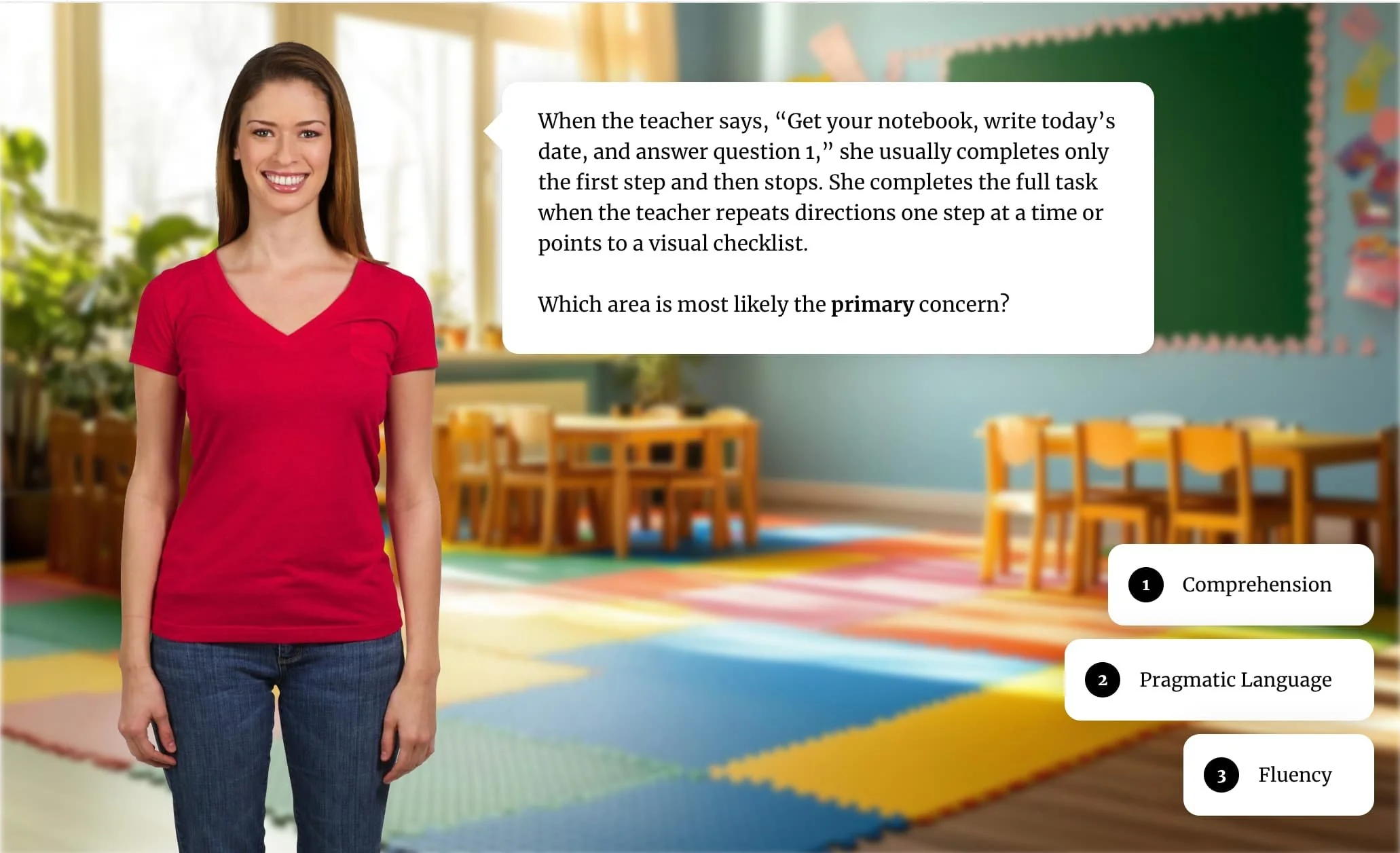
Educators apply SLP-informed clinical reasoning to real classroom scenarios, not just read about it
Take a skill like active listening. An SLP knows the difference between a student who needs more wait time and one who needs the language load reduced. They know when to fade support and when to intensify it. That clinical reasoning is now embedded in the plan. The educator doesn't need to figure it out on their own. They open the plan and the structure is already there.
“Can We Get This for Every Area?”
When I presented this work to special education supervisors at EUPISD, that was the first reaction.
These are experienced leaders who understand what it takes to shift practice in a district. They recognized that this kind of resource is exactly what educators need to feel confident enough to try intervention before moving to a more formal evaluation process.
Does Your District Have Expertise That's Hard to Reach?
Districts have deep knowledge. Reading specialists, math coaches, behavior support staff, and special education teams who know exactly what students need. What they often don't have is a way to make that expertise available to every educator who needs it, in a form that is clear, practical, and actually usable in a classroom.
That is an instructional design problem. And it's one worth solving well.
If your team has specialized knowledge that educators need but can't easily access, I'd love to talk. This is exactly the kind of work KShep Creative is built to do.
Ready to talk about your district’s needs?